Thursday, October 22, 2009
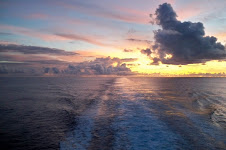
at sea in the Indian Ocean
While in Ghana, Milton visited a local school. He was horrified at what he saw in the school, broken windows, adilapidated building, no working bathrooms, no school supplies(pencils, paper, and such), very few desks...So Milton arranged tohave the school remodeled and up-dated to be a reasonable place to learn. He bought school supplies and mailed them back to the Ghanaian school from South Africa. Milton decided he was going to support moreschools in this way. He talked to Rob who is teaching a Non-profit Leadership class. Rob had Milton come and speak to his class about his school ideas. The next class, when Milton was not present, Rob asked the students if they would be interested inhelping Milton set up a non-profit organization to help the schools inGhana, one at a time, as Milton wanted. The entire class was thrilledwith the idea. In addition to doing their regular class work for Rob, they are going to, with Rob's guidance, set up Milton's organization according to Milton's plans and with Milton participating all the way. Rob knows exactly was they need to do to set up the organization tosucceed. I am very happy for all of them, including the schoolchildren. We are in the Indian Ocean in a place at the Equator referred toby sailors as the doldrums--where there is no wind. Sailors would haveto go into small boats and row to pull their sailing ships out of thedoldrums so they could continue on their way. Fortunately for us, wehave a motor and can keep right on moving straight throw the doldrums. Mauritius was an easy and relaxing port for all of us. Port Louis,the capitol, is where we docked. We took water taxis for $2 each wayto get to the wharf. From there we could go into all sorts of shops and then under a short tunnel and into the central market and beyond that to the public buses. The last day in Mauritius we took a public bus to one of the many famous and beautiful beaches for a swim in the Indian Ocean. We went to a large lagoon which had a choral reef separating us from the large ocean breakers and blocked us off from sharks. I loved swimming in the beautiful water. I went in intending to just get my feet wet. I had on a swim suit, so kept walking out into the water until I decided to swim. I rushed forward and was happily swimming away when I suddenly remembered that I had stuffed my wallet and my ship ID down the front of my swim suit. Luckily, nothing was ruined, just wet.I paid my water taxi fare back to the ship with two very wet dollar bills. The afternoon at the stunning beach was almost magical. Walking along the shore we passed two different baptism ceremonies going on in the Indian Ocean. The baptism included a very graceful dunking in the Indian Ocean. Those being baptised were all local black Mauritians whose ancestors were brought as slaves to plant and tend the sugarcane fields. The Island was uninhabited when settled by the Dutch 3 or 4 hundredyears ago. Many Indians were brought in to help with the labor in the fields. Mauritius is considered a "developing nation".They still grow sugar cane and have other industry. The largest industry is the tourist industry and they do a nice job with it. We took the public bus to the beach and back for two reasons, 1, the bus ride costs 85 cents and the taxi would be $35 each and 2 so we could see the countryside as we went. The only reason we could see for taking a taxi is that it would be quicker--20 minutes verses and hour on the bus. We figured we had an hour to look at the countryside andsee the locals. Again, while walking on the beach we came across three of our faculty friends from the ship, sitting on three padded and elegant beach chairs they had rented for the day along with a beach umbrella.They invited us to join them, which we did for several hours. They had befriended a handsome local young man who sold fresh, ripe, sweet, and juicy pineapples. We each got one and they were wonderful. The pineapple young man peeled the pineapple in such a way that we couldeat it, holding on to the stem, as if it were a large lollipop. Then we learned that our pineapple man had a twin brother at a lunch standwhere he sold wonderful barbecued sandwiches. When we got ready to leave, I wanted to change into dry clothes. One of our faculty friends walked me over (5 steps) to the man who had rented them the chairs and umbrella and asked him if I could chance clothes in theback of his van. He was very gracious and even closed both of the backdoors of his van for me. I thanked him afterward and gave him the equivalent of bus fare a a thank you. He assured me that money was not necessary, but I gave it to him anyway, just leaving it on his table.You may think that sounds cheap, but actually for them it was awelcome amount.As we walked off to leave we decided we needed some sort of lunch, so Rob and I walked the pineapple man's brother's foodstand and got a sandwich from the identical twin. Then I wanted something to drink. Now the only local money we had was a huge bill which no one at the beach seemed to be able to break. So we went back to our food stand twin and asked if he would sell us a soft drink forAmerican money. So he sold us a drink for a dollar and then told us that he needed to give us the exact change for the bus, so he sold us bus fare for another $2 and he gave us more than enough change because the bus fare was less than $1 each. Then he walked us over to the bus,and told us how to get the right one. All of us on the ship have had wonderful experiences with local people in almost every port (not Morocco). Rob and I have quit trying to bargain down the price of anything. The prices are already low, and the people need the money.We want them to have the money we spend. The sandwich we bought from the food stand twin was delicious. It was lots of barbecued chicken on a whole baguette. The bread was also delicious. The ride to and from the beach showed us mountains in the center of the island and beautiful beaches and coastline all around.t. The small towns we passed showed us very little wealth, but not the dire poverty we had seen in Ghana and South Africa. Mauritius reminded me of Puerto Rico, only not quite as poor.

Monday, October 12, 2009
at sea in the Indian Ocean
We are about 10 miles from Madagascar and almost a thousand miles from our next port, the small island of Mauritius.
Back to thoughts of Cape Town and South Africa--
Our trip to the Townships (the place where the black population was forced to live during Apartheid and where they live still, mainly for economic reasons) was sobering. I knew I would see mass poverty, but I could not imagine 2 million people living in one of 10 Townships mostly in makeshift shanties (with buckets for toilets) placed side by side by side for mile after mile after mile.The South African government is trying to replace the small (the size of our breakfast room at home) shacks, which have no running water, sewer, or electricity, with small houses made of cinder block, painted bright colors, with corrugated metal roofs, and running water and electricity, if the owner can pay the monthly utility fee. These new neighborhoods have streets and schools, but the schools are not anywhere near as good as the worst school in the entire United States--the Township schools do not have pencils, chalk, computers or more than a very few books. We walked, escorted by people of the neighborhood, called guides, paid to escort us and keep us safe, through one of the newest and best of the still slum neighborhoods in the newest and largest Township. Laughing, happy children danced along with us--holding our hands, delighted to see us. We were told by our tour guide, who grew up in and still chooses to live in a Township, not to give the children money--he said if we do we turn them into beggars. If we give them money, next time they will ask for it, soon they would stay out of school to beg.
Trash was in the streets. I had no trouble telling by the smell who was able to pay for running water and who was not. Unemployment in all of South Africa is 38%, in the Townships the number is double. Imagine almost 80% of 2 million people living with no income. Some people had small stores for basic food, a few ran beauty parlors and barbershops. These business were exactly like the tiny makeshift shops in Ghana. Residents had to walk miles to get to public transportation in order to get to Cape Town. Then, if you have the fare, the bus takes an hour or more to get to Cape Town where the most fortunate have jobs.
We were taken to a couple of government-run shops where people sold things they had made. Our tour guide asked us not to bargain down to the lowest price we could get, please just bargain down to the lowest price we are willing to pay. The people need to earn a living. We all found things to buy and we paid the asking price--$3 each for Christmas ornaments, $2 each for earrings...
Some black people have been able to rise out of poverty and even into wealth now that Apartheid has been abolished. Many of these wealthy black people, who can afford nice houses and nice cars, tend to chose to live in nice houses in the Townships because they want to support the people who still live there and because their friends are here and their culture is here. Racism is still rampant in South Africa even though the laws are now fair. Black people are legally allowed to live in Cape Town, but they are not welcome there. Black neighborhoods are still kept out of sight of beautiful Cape Town itself.
We learned from talking with people in the Townships that most of the children living in the Township have never seen the coast. The Townships are on a peninsula surrounded by the ocean. We passed beautiful coastlines on the bus on the way to the Townships. Individuals live their whole lives without ever leaving the Township in which they were born. Aids and alcoholism are rampant and keep the black population in poverty and despair.
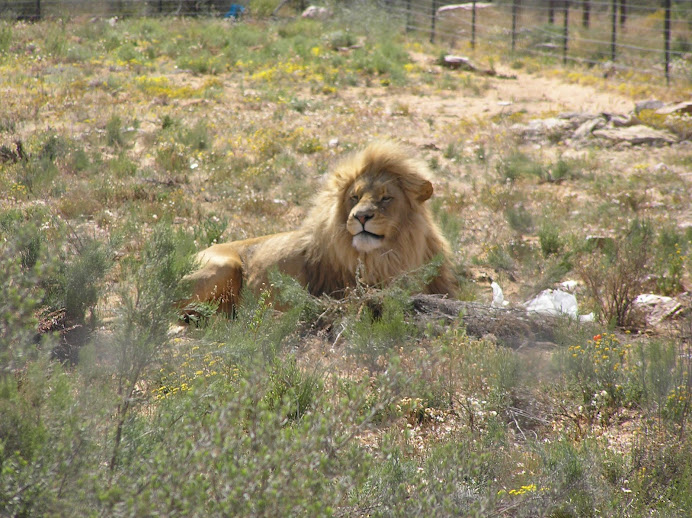
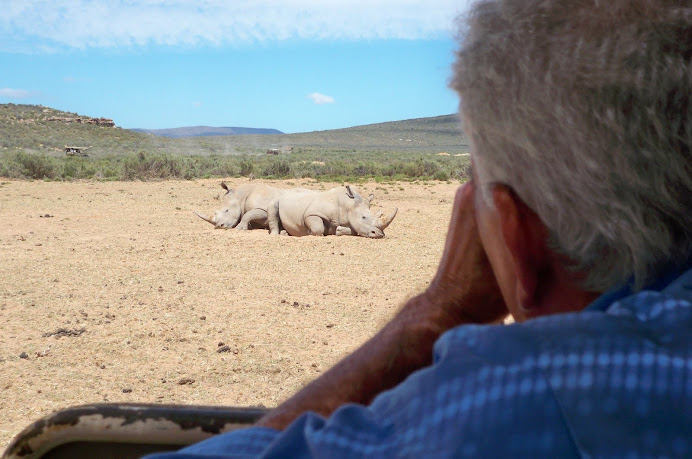
In Cape Town the houses are lovely, the neighborhoods are all very well kept. The best neighborhoods are surrounded by high walls. All of the houses and apartment buildings are surrounded by high walls, with heavy, metal, locked gates. The windows have heavy metal bars. Security is heavier than any I have ever seen before. Violent crime is among the highest in the world. The murder rate is the third highest of any major city. A woman is raped every 40 seconds in South Africa. Amidst breathtakingly beautiful surroundings, the white population are living as prisoners in their own homes. During Apartheid, 13% of the population was white. Now the number is 9% and still dropping. If we had stayed inside of Cape Town, and not looked too closely, we would have seen an ideal place to live. We were treated well everywhere we went. The bus ride (we always have brand-new, comfortable tour buses) of2 1/2 hours to the Aquila Game Preserve took us into a huge, lush valley covered with the green vineyards where grapes are grown for the South African wines which are appreciated world-wide. On each end of the valley were mountains a bit like the Rockies, but not a stark and not as high. Upon arrival at the game preserve, we were fed a delicious breakfast, and then sent out in long jeeps, all of us armed with cameras, for 2 1/2 hours on jeep trails where our guide stopped each time he spotted wild animals, so we could take pictures while he told us all about the animal we were seeing. He was a blue-eyed blond who spoke English with an Afrikaners accent and who had spent his whole life in South Africa. We all liked him and were impressed by all he taught us.
One rainy afternoon we ducked into the 6 star hotel right on the wharf directly in front of our ship. We noticed that tea was being served in a beautiful dinning room with huge tall windows, three stories high, looking out on the bay. We decided to have high tea and thus spent a lovely afternoon, out of the rain, looking at a beautiful view, chatting with each other while being served more delicious treats than we could possibly eat, along with the best big pot of tea I have ever had. For our further entertainment, a few small song birds had gotten in and were occasionally flying across the room high above our heads, as if they had been hired by the hotel to look charming while we dined.
South Africa was fascinating, stunning, shocking. I am glad we came, glad we saw.
Back to thoughts of Cape Town and South Africa--
Our trip to the Townships (the place where the black population was forced to live during Apartheid and where they live still, mainly for economic reasons) was sobering. I knew I would see mass poverty, but I could not imagine 2 million people living in one of 10 Townships mostly in makeshift shanties (with buckets for toilets) placed side by side by side for mile after mile after mile.The South African government is trying to replace the small (the size of our breakfast room at home) shacks, which have no running water, sewer, or electricity, with small houses made of cinder block, painted bright colors, with corrugated metal roofs, and running water and electricity, if the owner can pay the monthly utility fee. These new neighborhoods have streets and schools, but the schools are not anywhere near as good as the worst school in the entire United States--the Township schools do not have pencils, chalk, computers or more than a very few books. We walked, escorted by people of the neighborhood, called guides, paid to escort us and keep us safe, through one of the newest and best of the still slum neighborhoods in the newest and largest Township. Laughing, happy children danced along with us--holding our hands, delighted to see us. We were told by our tour guide, who grew up in and still chooses to live in a Township, not to give the children money--he said if we do we turn them into beggars. If we give them money, next time they will ask for it, soon they would stay out of school to beg.
Trash was in the streets. I had no trouble telling by the smell who was able to pay for running water and who was not. Unemployment in all of South Africa is 38%, in the Townships the number is double. Imagine almost 80% of 2 million people living with no income. Some people had small stores for basic food, a few ran beauty parlors and barbershops. These business were exactly like the tiny makeshift shops in Ghana. Residents had to walk miles to get to public transportation in order to get to Cape Town. Then, if you have the fare, the bus takes an hour or more to get to Cape Town where the most fortunate have jobs.
We were taken to a couple of government-run shops where people sold things they had made. Our tour guide asked us not to bargain down to the lowest price we could get, please just bargain down to the lowest price we are willing to pay. The people need to earn a living. We all found things to buy and we paid the asking price--$3 each for Christmas ornaments, $2 each for earrings...
Some black people have been able to rise out of poverty and even into wealth now that Apartheid has been abolished. Many of these wealthy black people, who can afford nice houses and nice cars, tend to chose to live in nice houses in the Townships because they want to support the people who still live there and because their friends are here and their culture is here. Racism is still rampant in South Africa even though the laws are now fair. Black people are legally allowed to live in Cape Town, but they are not welcome there. Black neighborhoods are still kept out of sight of beautiful Cape Town itself.
We learned from talking with people in the Townships that most of the children living in the Township have never seen the coast. The Townships are on a peninsula surrounded by the ocean. We passed beautiful coastlines on the bus on the way to the Townships. Individuals live their whole lives without ever leaving the Township in which they were born. Aids and alcoholism are rampant and keep the black population in poverty and despair.
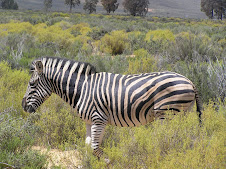
In Cape Town the houses are lovely, the neighborhoods are all very well kept. The best neighborhoods are surrounded by high walls. All of the houses and apartment buildings are surrounded by high walls, with heavy, metal, locked gates. The windows have heavy metal bars. Security is heavier than any I have ever seen before. Violent crime is among the highest in the world. The murder rate is the third highest of any major city. A woman is raped every 40 seconds in South Africa. Amidst breathtakingly beautiful surroundings, the white population are living as prisoners in their own homes. During Apartheid, 13% of the population was white. Now the number is 9% and still dropping. If we had stayed inside of Cape Town, and not looked too closely, we would have seen an ideal place to live. We were treated well everywhere we went. The bus ride (we always have brand-new, comfortable tour buses) of2 1/2 hours to the Aquila Game Preserve took us into a huge, lush valley covered with the green vineyards where grapes are grown for the South African wines which are appreciated world-wide. On each end of the valley were mountains a bit like the Rockies, but not a stark and not as high. Upon arrival at the game preserve, we were fed a delicious breakfast, and then sent out in long jeeps, all of us armed with cameras, for 2 1/2 hours on jeep trails where our guide stopped each time he spotted wild animals, so we could take pictures while he told us all about the animal we were seeing. He was a blue-eyed blond who spoke English with an Afrikaners accent and who had spent his whole life in South Africa. We all liked him and were impressed by all he taught us.
One rainy afternoon we ducked into the 6 star hotel right on the wharf directly in front of our ship. We noticed that tea was being served in a beautiful dinning room with huge tall windows, three stories high, looking out on the bay. We decided to have high tea and thus spent a lovely afternoon, out of the rain, looking at a beautiful view, chatting with each other while being served more delicious treats than we could possibly eat, along with the best big pot of tea I have ever had. For our further entertainment, a few small song birds had gotten in and were occasionally flying across the room high above our heads, as if they had been hired by the hotel to look charming while we dined.
South Africa was fascinating, stunning, shocking. I am glad we came, glad we saw.
at sea after Cape Town
I have managed to get new pictures posted both along the side and at the bottom.
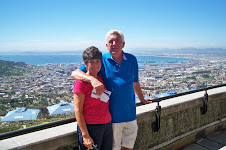
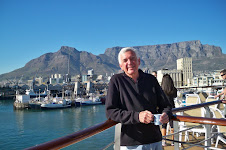
Cape Town was a rich experience, both good and disturbing. The first day we took a cable car up to the top of Table Mountain which rises straight up from the heart of Cape Town. Our ship anchored in Table Bay in the center of the luxurious wharf area, with nice restaurants, shops, two luxury hotels and a very modern mall with elegant stores carrying luxury brands. We could see the ship, looking like a small toy, from the top of Table Mountain. The views from Table Mountain were breathtakingly beautiful from all four sides and from every angle. You can imagine Rob's disappointment when, after three pictures, the camera battery died and he didn't have a back-up camera. So we took in all of the stunning views with just our own eyes--and stored the memory in our own heads to last the rest of our lives. We will never forget Table Mountain.
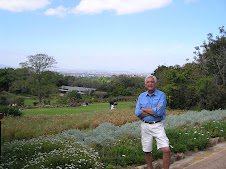
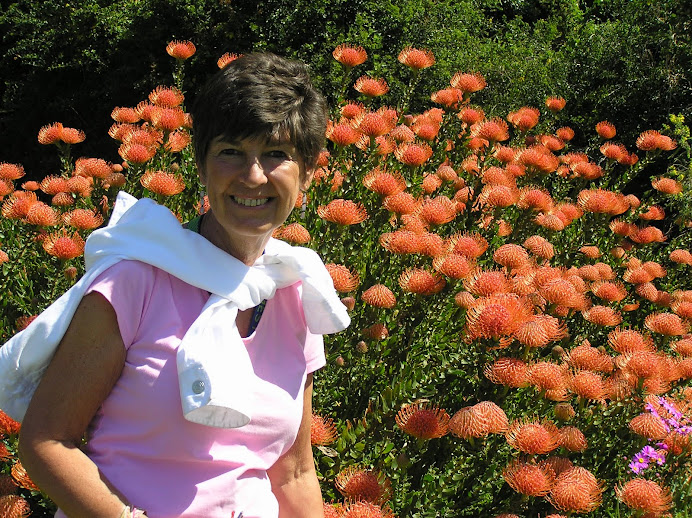
The next day we went to the Sunday market (open only on Sunday) a bought some African-made presents we like for us and for others. Next stop was the world class botanical garden. This time we had two cameras and neither gave out. The pictures are spectacular. The huge gardens with miles of paths and lawns and African plants and flowers is a World Heritage Site, and for good reason.
Cape Town was a rich experience, both good and disturbing. The first day we took a cable car up to the top of Table Mountain which rises straight up from the heart of Cape Town. Our ship anchored in Table Bay in the center of the luxurious wharf area, with nice restaurants, shops, two luxury hotels and a very modern mall with elegant stores carrying luxury brands. We could see the ship, looking like a small toy, from the top of Table Mountain. The views from Table Mountain were breathtakingly beautiful from all four sides and from every angle. You can imagine Rob's disappointment when, after three pictures, the camera battery died and he didn't have a back-up camera. So we took in all of the stunning views with just our own eyes--and stored the memory in our own heads to last the rest of our lives. We will never forget Table Mountain.
The next day we went to the Sunday market (open only on Sunday) a bought some African-made presents we like for us and for others. Next stop was the world class botanical garden. This time we had two cameras and neither gave out. The pictures are spectacular. The huge gardens with miles of paths and lawns and African plants and flowers is a World Heritage Site, and for good reason.
Friday, October 2, 2009
More about Ghana
The Ghanians want to develop an active tourist trade--but they aren'tready for it yet. Roads are totally inadiquate. Well over 75 people from our ship (that's just the ones who went to the clinic and got tested) develped E Coli from food in Ghana, even though none of us drank the local water or ate food not cooked. We all came with medicine, so all are fine now--but people were horribly sick for days. I sent a post card from the only place I saw that had them--the castle of Elmina, overlooking the sea.
Morocco, on the other hand, had a well developed tourinst industry that provided phoney tourist experiences which were what the Moroccan's seemed to think the Americans and Europeans expected.
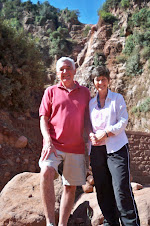
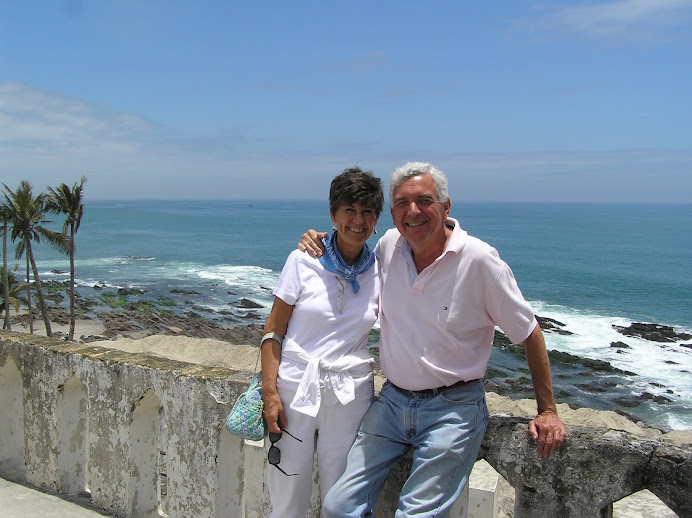
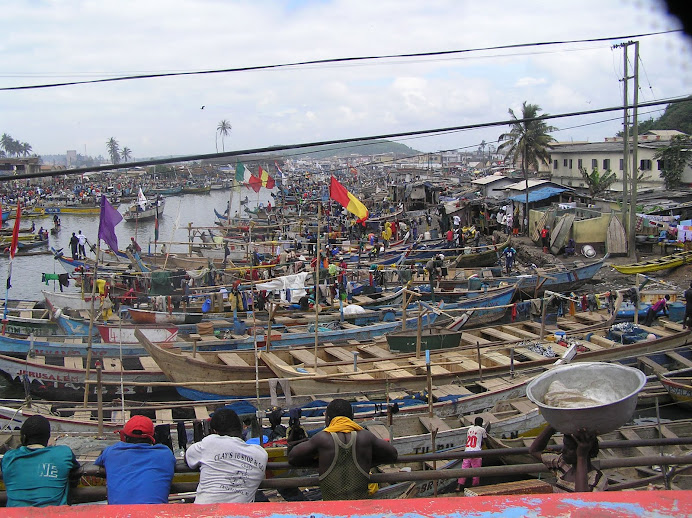
Slaves in Ghana were kept in dungeons at Elmina Castle and the Cape Coast Castle(where we had tours), among others, to be shipped to the Caribbean and then to South and North America. The slave trade was so horrendous that I will not even describe what we saw. I included a picture of the two of us at the beautiful castle overlooking the sea, where local fishermen go out every day by the hundreds, fishing for one of their main food staples. The people earn their living by fishing and/or farming. Fiftypercent of their food is still imported, so the small farmers (there are no large farms) do not grow enough to feed even just the people of Ghana.
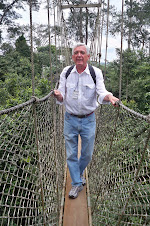
Rob went on a trip I missed (I just need to take a day off to restup) to a national park in the rain forest. I sent a photo of Rob walking across the swinging bridge in the canopy of the rain forest.He loved it.
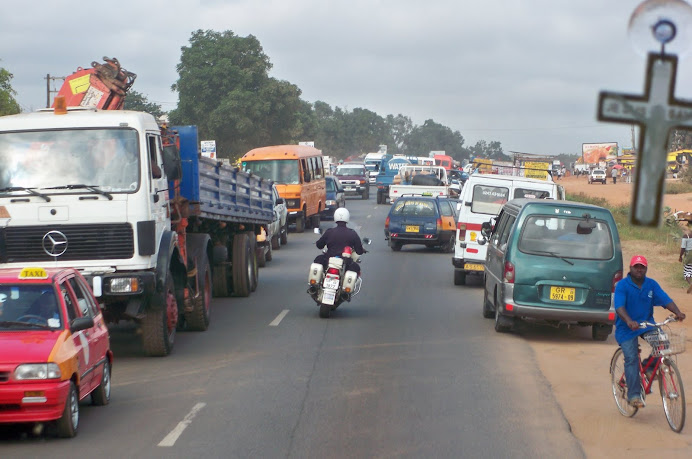
His trip began with a traffic adventure. The roads ofGhana are clogged with traffic at all times. The guide for this particular trip had a friend on the police force who lead their big tour bus with his motorcycle. Cars pulled off the road to the left and right. It was very exciting. The bus went fast right through the path cut by the policeman on his motorcycle--sometimes pulling over, with the bus right behind, onto the opposite side of the road into oncoming traffic, which pulled off the road quickly to get out of the way. Look at the picture of the motorcycle (below) taken through the front window of the bus and imagine a big bus speeding right behind.
Ghana is full of vehicles. Over 95% of transportation moves by cars on the highways which are totally overwhelmed by the traffic. Having the policeman at the beginning of the trip was great--but they were still 5 hours late getting back to the ship because the bus broke down and the trafficwas horrible. Trip after trip got back to the bus late. Some people had 12 and 18 hour bus trips because of traffic and delays at boarders. It took Rob's group 7 hours to get back from what was supposedto be a 3 hour return trip.
I sent Liza a picture of her Dad kissing a fish as we crossed the
Equator--part of a day of silly ceremonies. Apparently it struck
Schuyler as hilariously funny and he rolled over laughing. That humor
is clearly a guy thing. I am glad he enjoyed it.
I still love shipboard life. Tomorrow we land at Cape Town to spend
6 days there. I am looking forward to it very much in spite of a
pre-port meeting last night telling us how dangerous South Africa can
be for us. We can drink the water and walk freely around the
commercial area near the port. But the violent crime rate is high,
credit card theft is high, and aids is more prevalent than anywhere
else in the world. We are not to go into the Township around Cape Town
(the slums around Cape Town) unless we are part of an official tour
group with a local guide, no taxis to Townships because it is too
dangerous to us. I want to go--but will heed the warning and go only
on a group tour with Rob. I am not a risk taker.
Morocco, on the other hand, had a well developed tourinst industry that provided phoney tourist experiences which were what the Moroccan's seemed to think the Americans and Europeans expected.
Slaves in Ghana were kept in dungeons at Elmina Castle and the Cape Coast Castle(where we had tours), among others, to be shipped to the Caribbean and then to South and North America. The slave trade was so horrendous that I will not even describe what we saw. I included a picture of the two of us at the beautiful castle overlooking the sea, where local fishermen go out every day by the hundreds, fishing for one of their main food staples. The people earn their living by fishing and/or farming. Fiftypercent of their food is still imported, so the small farmers (there are no large farms) do not grow enough to feed even just the people of Ghana.
Rob went on a trip I missed (I just need to take a day off to restup) to a national park in the rain forest. I sent a photo of Rob walking across the swinging bridge in the canopy of the rain forest.He loved it.
His trip began with a traffic adventure. The roads ofGhana are clogged with traffic at all times. The guide for this particular trip had a friend on the police force who lead their big tour bus with his motorcycle. Cars pulled off the road to the left and right. It was very exciting. The bus went fast right through the path cut by the policeman on his motorcycle--sometimes pulling over, with the bus right behind, onto the opposite side of the road into oncoming traffic, which pulled off the road quickly to get out of the way. Look at the picture of the motorcycle (below) taken through the front window of the bus and imagine a big bus speeding right behind.
Ghana is full of vehicles. Over 95% of transportation moves by cars on the highways which are totally overwhelmed by the traffic. Having the policeman at the beginning of the trip was great--but they were still 5 hours late getting back to the ship because the bus broke down and the trafficwas horrible. Trip after trip got back to the bus late. Some people had 12 and 18 hour bus trips because of traffic and delays at boarders. It took Rob's group 7 hours to get back from what was supposedto be a 3 hour return trip.
I sent Liza a picture of her Dad kissing a fish as we crossed the
Equator--part of a day of silly ceremonies. Apparently it struck
Schuyler as hilariously funny and he rolled over laughing. That humor
is clearly a guy thing. I am glad he enjoyed it.
I still love shipboard life. Tomorrow we land at Cape Town to spend
6 days there. I am looking forward to it very much in spite of a
pre-port meeting last night telling us how dangerous South Africa can
be for us. We can drink the water and walk freely around the
commercial area near the port. But the violent crime rate is high,
credit card theft is high, and aids is more prevalent than anywhere
else in the world. We are not to go into the Township around Cape Town
(the slums around Cape Town) unless we are part of an official tour
group with a local guide, no taxis to Townships because it is too
dangerous to us. I want to go--but will heed the warning and go only
on a group tour with Rob. I am not a risk taker.
Wednesday, September 30, 2009
post Ghana
New photos at bottom and along side.
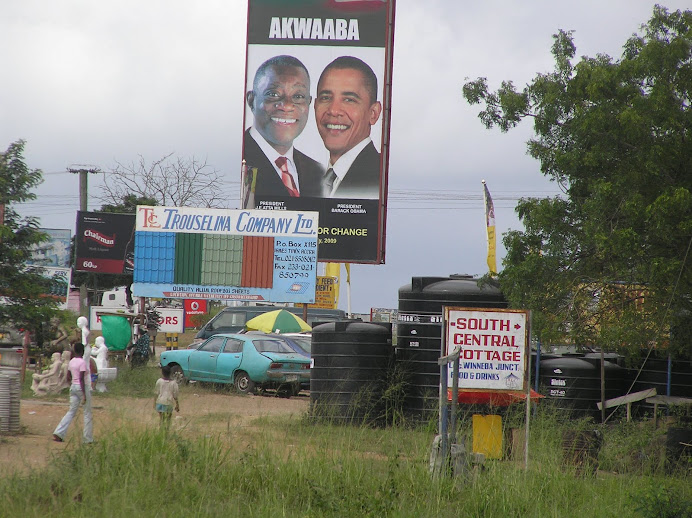
The most popular man in Ghana is, without a doubt, Barack Obama.Every one asks about him the minute they see us. We stand out because those of us who are white are the only white people any where we go in the country. There are huge billboards along every road with pictures of Obama, many depict him beside a local, or at least a Ghanaian, politician. Any connection with Obama will bring them votes.
The Ghanaian people are friendly and gracious to us everywhere.They want to talk with us and get to know us. They are all happy that we have come to their country. Everyone on the ship was treated well where ever they went in Ghana.
Their teeth are stark white and shinning and perfect--far better than our own. They all brush their teeth with the bark of a particular tree that is cut into a brush-like shape. Apparently this bark has medicinal powers for teeth. I can't believe no one has yet cut downall of these trees and shipped them to Europe and America--we seem to have striped the land of everything else for our own benefit. Don't tell anyone so maybe they can keep their teeth brushing trees. We all wish these warm and friendly people the very best.
In spite of companies such as Nestle having factories here, most people are unemployed or earning less than they need to live on. Some guides quoted unemployment at 50% We could see for ourselves that it was very high. It costs $60 a month for an apartment in Accra, but most people can't afford it because they have to pay two years in advance before they can move in. So many sleep on the ground in front of their small shops. Many shops are too small to get into to sleep.
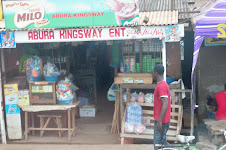
Street hawking is illegal--which makes all of us laugh because there are hundreds of people on the sides of the road who run into the street selling anything you can think of. Imagine emptying out a whole Walmart (one with a grocery store) and putting item by item, each product piled high on someones head for them to carry out to the street to sell. Just to be clear there are no Walmart Stores in Ghana--no big stores of any kind. The business are small ones in small sheds, too small to enter, that sell one thing (often stacked in front of the shop)for example, chairs,all alike, beds, all hand-made and all alike, limes only, bananas only, cinder blocks only. cement only, used tires, chocolate candy,plantain chips...
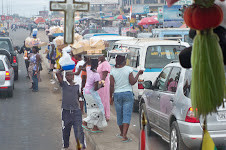
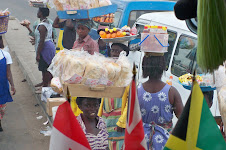
I find it hard to understand why there are so many cars in such a poor country. There are taxis, vans, many mopeds, small motorcycles, some bicycles, trucks... Most people walk. So you get the idea of how many people live here--millions.The sides of the roads and the cities are teeming with masses of people walking, many with loads on their heads, lots selling the items on their heads, but others just going home with stuff on their head. The women wear long skirts, and some wear long slacks, men mostly wear long pants, children all wear school uniforms and look neat (as in clean and tidy). There are many private church-related schools, but some public schools which also require uniforms. The public schools are not comparable to the private schools. Illiteracy is high, I don't have a percentage. All babies and toddlers are carried, mostly by woman and mostly on their backs in cloth. The children everywhere run up to us and want to talk with us, love the cameras and love to pose, and are delighted to look at the camera and see a picture of themselves. Fortunately for us the official language of Ghana is still English (because it was part of the British Empire until 1957) so we have no troublespeaking with people. All of these people speak their own ethnic language at home, and most speak several local languages.
Religion in Ghana is visible everywhere. The majority of people(60% or more) are Christan--mostly evangelical, fundamental. The missionaries have done their work. They were even here, living in the castles housing slaves packed into dungeons, holding services while inhuman practices were going on around them. The tiny shops along the roads have names such as, "Jesus Saves" Tires, "Psalm 24" Tomatoes,"God Loves You" Cement, etc.. There are many church-related schools,Methodist, LDS, Jehovah's Witness, Anglican...I saw many of them with all of their students in uniforms. Muslims are about 16%, Catholics are here. The main thing is that religious freedom reigns in Ghana, individuals here choose to participate in whatever church they want. And almost everyone chooses to belong to a church. The churches seem to be as poor as the people. No grand cathedrals or huge, beautiful mosques (as in Casablanca) here.
The most popular man in Ghana is, without a doubt, Barack Obama.Every one asks about him the minute they see us. We stand out because those of us who are white are the only white people any where we go in the country. There are huge billboards along every road with pictures of Obama, many depict him beside a local, or at least a Ghanaian, politician. Any connection with Obama will bring them votes.
The Ghanaian people are friendly and gracious to us everywhere.They want to talk with us and get to know us. They are all happy that we have come to their country. Everyone on the ship was treated well where ever they went in Ghana.
Their teeth are stark white and shinning and perfect--far better than our own. They all brush their teeth with the bark of a particular tree that is cut into a brush-like shape. Apparently this bark has medicinal powers for teeth. I can't believe no one has yet cut downall of these trees and shipped them to Europe and America--we seem to have striped the land of everything else for our own benefit. Don't tell anyone so maybe they can keep their teeth brushing trees. We all wish these warm and friendly people the very best.
In spite of companies such as Nestle having factories here, most people are unemployed or earning less than they need to live on. Some guides quoted unemployment at 50% We could see for ourselves that it was very high. It costs $60 a month for an apartment in Accra, but most people can't afford it because they have to pay two years in advance before they can move in. So many sleep on the ground in front of their small shops. Many shops are too small to get into to sleep.
Street hawking is illegal--which makes all of us laugh because there are hundreds of people on the sides of the road who run into the street selling anything you can think of. Imagine emptying out a whole Walmart (one with a grocery store) and putting item by item, each product piled high on someones head for them to carry out to the street to sell. Just to be clear there are no Walmart Stores in Ghana--no big stores of any kind. The business are small ones in small sheds, too small to enter, that sell one thing (often stacked in front of the shop)for example, chairs,all alike, beds, all hand-made and all alike, limes only, bananas only, cinder blocks only. cement only, used tires, chocolate candy,plantain chips...
I find it hard to understand why there are so many cars in such a poor country. There are taxis, vans, many mopeds, small motorcycles, some bicycles, trucks... Most people walk. So you get the idea of how many people live here--millions.The sides of the roads and the cities are teeming with masses of people walking, many with loads on their heads, lots selling the items on their heads, but others just going home with stuff on their head. The women wear long skirts, and some wear long slacks, men mostly wear long pants, children all wear school uniforms and look neat (as in clean and tidy). There are many private church-related schools, but some public schools which also require uniforms. The public schools are not comparable to the private schools. Illiteracy is high, I don't have a percentage. All babies and toddlers are carried, mostly by woman and mostly on their backs in cloth. The children everywhere run up to us and want to talk with us, love the cameras and love to pose, and are delighted to look at the camera and see a picture of themselves. Fortunately for us the official language of Ghana is still English (because it was part of the British Empire until 1957) so we have no troublespeaking with people. All of these people speak their own ethnic language at home, and most speak several local languages.
Religion in Ghana is visible everywhere. The majority of people(60% or more) are Christan--mostly evangelical, fundamental. The missionaries have done their work. They were even here, living in the castles housing slaves packed into dungeons, holding services while inhuman practices were going on around them. The tiny shops along the roads have names such as, "Jesus Saves" Tires, "Psalm 24" Tomatoes,"God Loves You" Cement, etc.. There are many church-related schools,Methodist, LDS, Jehovah's Witness, Anglican...I saw many of them with all of their students in uniforms. Muslims are about 16%, Catholics are here. The main thing is that religious freedom reigns in Ghana, individuals here choose to participate in whatever church they want. And almost everyone chooses to belong to a church. The churches seem to be as poor as the people. No grand cathedrals or huge, beautiful mosques (as in Casablanca) here.
Wednesday, September 23, 2009
Ghana
We are in port about a 30 minute bus ride to Accra, Ghana. Rob and went on a trip yesterday with our Dean, Bob Chapel, and his wife and other faculty and students to the Communications College of the University of Ghana. We were treated as honored guests. We were ushered from the bus to chairs set up in the shade to watch a very lively performance of dance and music by about 9 young men and 4 young woman who looked to be students. They had matching cotton costumes and looked as if they loved every minute of the performance. I can't imagine how they had the energy to dance so hard and so fast every second for about 30 minutes. We all enjoyed the performance. Then were were ushered up stairs to have a typical Ghanaian lunch (feast is more like it). The food was very good. Their own food is quite spicy hot, so they had some plain rice and a few not spicy dishes which I think were just for us. We ate at round tables with their own college students and faculty mixed in with ours. After lunch they had a lecture for us by one of their faculty members. Then more dancing and singing and drum playing before we left. The official language is English, but each of the hundred or so ethnic groups (they do not use the word "Tribe" and are, in fact, offended by it) has its own language. The student seated next to me spoke five languages and had never been out of Ghana, maybe not even far out of Accra. Some students live in a dormitory, but many live in Accra with their families (as did the student next to me).
The road in from the ship is a nice big highway, in good repair. What we saw on the about 45 minute drive to the College a great deal of poverty--many huts and small (tiny) business made haphazardly of wooden boxes and such with corrugated metal roofs. We passed over a hundred people selling things by the side of the road. At stop lights they ran into the street selling things to the people in cars. Here are some of the items I remember being sold, banana chips, bread (as in wonder bread type bread in plastic bags, cold drinks--coca cola and such--, soccer balls, pretzels, melons, and maps. More was for sale. Apparently local people by food and such from these vendors. Many vendors or most had large bowls or trays balanced on their heads. Mostly woman, but also many men. They were all very good a balancing heavy loads on their heads. Other people walking in the streets used their heads to carry heavy loads.
The traffic was heavy, so there are lots of cars here. The local industry includes a Coca-cola plant, a Nestles Plant, Steel plants, all using local natural resources. The coco plant thrives here, even though it is not native to Ghana, and coco beans are the largest part of the Ghanaian economy. You probably already know that Ghana is rich in natural resources including gold, diamonds, bauxite, coco beans--and now oil has been discovered off shore. Ghana has a wealth of natural resources enriching the Colonial powers originally (the English, Dutch, French) but not the people of Ghana who are quite poor. Now foreign investors now reap the rewards of Ghanaian resources. We Semester at Sea people hope that the Ghanaians will find a way to share in the money from the new-found oil. Ghana does no have the money to invest nor the expertise among its people to drill for the oil. Could the oil be one of the many reasons Obama came here? I am not speaking against our President. Ghana is the safest, most democratic, and possibly the least poor country in Africa--all things Obama would want to encourage. Being less poor does not keep Ghana from being grindingly poor. There are some wealthy and some middle class Ghanaians, but the vast majority are not.
I don't ever in my life remember being in such a racially homogeneous group of people.
Lunch time.
The road in from the ship is a nice big highway, in good repair. What we saw on the about 45 minute drive to the College a great deal of poverty--many huts and small (tiny) business made haphazardly of wooden boxes and such with corrugated metal roofs. We passed over a hundred people selling things by the side of the road. At stop lights they ran into the street selling things to the people in cars. Here are some of the items I remember being sold, banana chips, bread (as in wonder bread type bread in plastic bags, cold drinks--coca cola and such--, soccer balls, pretzels, melons, and maps. More was for sale. Apparently local people by food and such from these vendors. Many vendors or most had large bowls or trays balanced on their heads. Mostly woman, but also many men. They were all very good a balancing heavy loads on their heads. Other people walking in the streets used their heads to carry heavy loads.
The traffic was heavy, so there are lots of cars here. The local industry includes a Coca-cola plant, a Nestles Plant, Steel plants, all using local natural resources. The coco plant thrives here, even though it is not native to Ghana, and coco beans are the largest part of the Ghanaian economy. You probably already know that Ghana is rich in natural resources including gold, diamonds, bauxite, coco beans--and now oil has been discovered off shore. Ghana has a wealth of natural resources enriching the Colonial powers originally (the English, Dutch, French) but not the people of Ghana who are quite poor. Now foreign investors now reap the rewards of Ghanaian resources. We Semester at Sea people hope that the Ghanaians will find a way to share in the money from the new-found oil. Ghana does no have the money to invest nor the expertise among its people to drill for the oil. Could the oil be one of the many reasons Obama came here? I am not speaking against our President. Ghana is the safest, most democratic, and possibly the least poor country in Africa--all things Obama would want to encourage. Being less poor does not keep Ghana from being grindingly poor. There are some wealthy and some middle class Ghanaians, but the vast majority are not.
I don't ever in my life remember being in such a racially homogeneous group of people.
Lunch time.
Monday, September 21, 2009
Ghana tomorrow
James Godfrey saw a hammer-head shark swimming along beside the ship yesterday. Poor thing won't get much--we dump no garbage, actually nothing at all into the sea--we are an environmentally friendly ship. We make our own water for drinking, bathing, brushing teeth, etc. out of sea water. It all looks and tastes just fine. The water goes through a number of filtering processes that work well for us. Then in port we buy all the water we need while we are there. So we have no laundry service in port and are asked to conserve every drop we can.
Last night we went to a fancy dinner in a lovely private dinning room to say farewell to five people among the Life Long Learners and faculty who are leaving the ship in Ghana. They all had signed on for just a part of the voyage, so their departure had been planned from the beginning. Still they seemed sad to be leaving. Those of us attending the dinner had been specifically invited by one of the five. Linda Davis, a faculty member from the Bahamas who teaches at the University of the Bahamas, invited us. These special gourmet dinners cost $25 a person and we all paid our own way. I am glad I get to be on board for the whole vouyage.
Rob and I are already saying we want to come back to Semester at Sea for more voyages. There is one around the Mediterranean, one through the Panama Canel, one to the Carabean, and one to South America. So our particular itennery is by no means they only choice. The ship is always on the move with different length voyages. The whole semester trips, such as ours, take almost 4 months and are the longest. We ae on the fall voyage--the spring semester voyage reverses or itinerary.
By the way, our visit to Ghana is quite special because we are the largest group of Americans to visit Ghana at one time ever. Semester at Sea has never been here before, so we are blazing a trail for them. President Obama, I guess, blazed a trail for us (though he was by no means the first American to visit--maybe the first American President?). We have a Ghanian faculty member and a Ghanian student who were brough on board at Casablanca to ride with us and to teach us about Ghana before we disembark there. We get such experts before most ports.
Last night we went to a fancy dinner in a lovely private dinning room to say farewell to five people among the Life Long Learners and faculty who are leaving the ship in Ghana. They all had signed on for just a part of the voyage, so their departure had been planned from the beginning. Still they seemed sad to be leaving. Those of us attending the dinner had been specifically invited by one of the five. Linda Davis, a faculty member from the Bahamas who teaches at the University of the Bahamas, invited us. These special gourmet dinners cost $25 a person and we all paid our own way. I am glad I get to be on board for the whole vouyage.
Rob and I are already saying we want to come back to Semester at Sea for more voyages. There is one around the Mediterranean, one through the Panama Canel, one to the Carabean, and one to South America. So our particular itennery is by no means they only choice. The ship is always on the move with different length voyages. The whole semester trips, such as ours, take almost 4 months and are the longest. We ae on the fall voyage--the spring semester voyage reverses or itinerary.
By the way, our visit to Ghana is quite special because we are the largest group of Americans to visit Ghana at one time ever. Semester at Sea has never been here before, so we are blazing a trail for them. President Obama, I guess, blazed a trail for us (though he was by no means the first American to visit--maybe the first American President?). We have a Ghanian faculty member and a Ghanian student who were brough on board at Casablanca to ride with us and to teach us about Ghana before we disembark there. We get such experts before most ports.
Subscribe to:
Posts (Atom)